
Weightlifting at the 2016 Summer Olympics
260 athletes competed in 15 weightlifting events at Rio 2016.
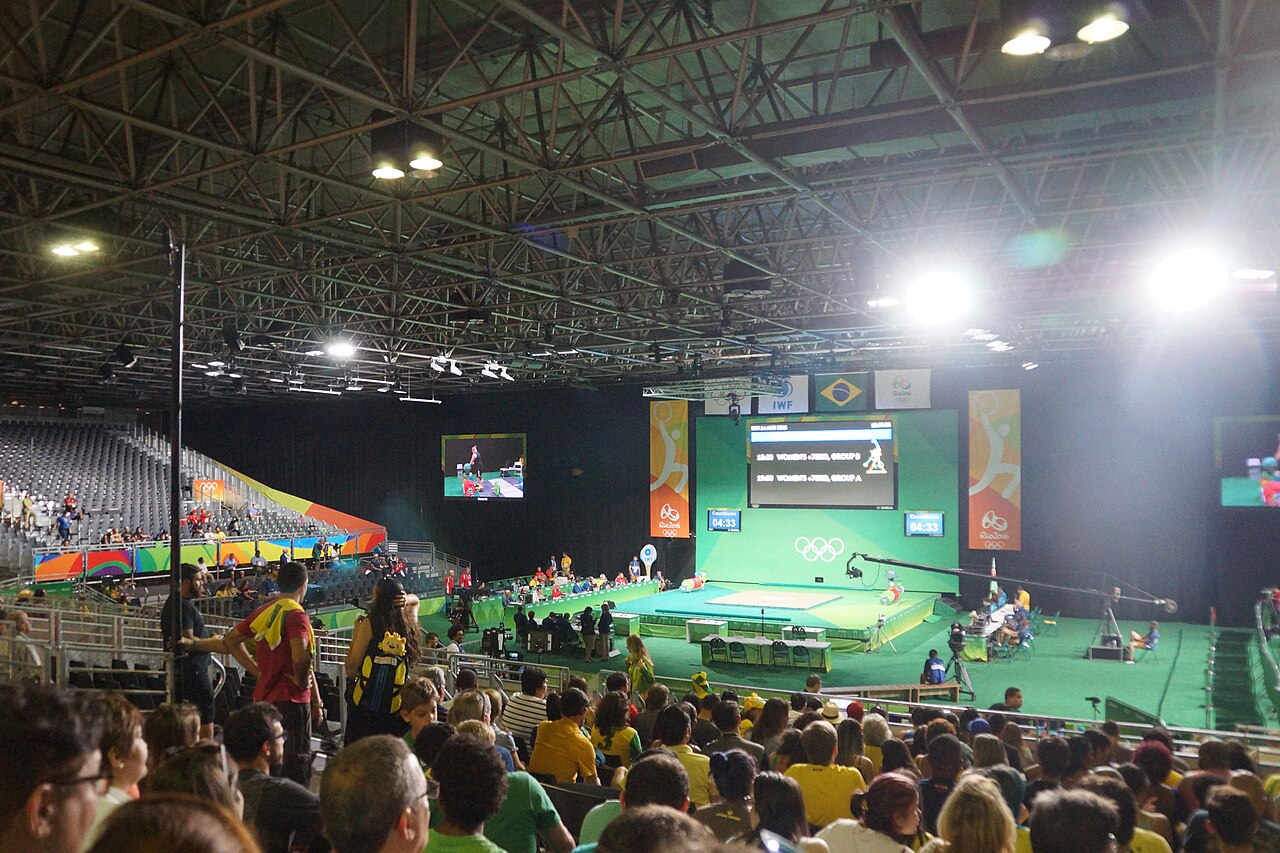
The weightlifting events at the 2016 Summer Olympics were held in Rio de Janeiro's Riocentro, Pavilion 2, from August 6 to 16. A total of 260 athletes—156 men and 104 women—competed across 15 weight categories. Both Bulgaria and Russia were barred from the sport due to systematic doping violations.
Fifteen medal events were contested. The competition schedule featured up to three daily sessions: a morning session from 10:00 to 14:00 BRT, an afternoon session from 15:30 to 17:30 BRT, and an evening session from 19:00 to 21:00 BRT.
Qualification followed the 2012 format, with 260 total spots split between team and individual berths. Host nation Brazil received three automatic men's and two women's entries. Ten spots (six for men, four for women) were allocated via Tripartite Commission invitations, leaving the remaining places open for qualification in both men's and women's events.
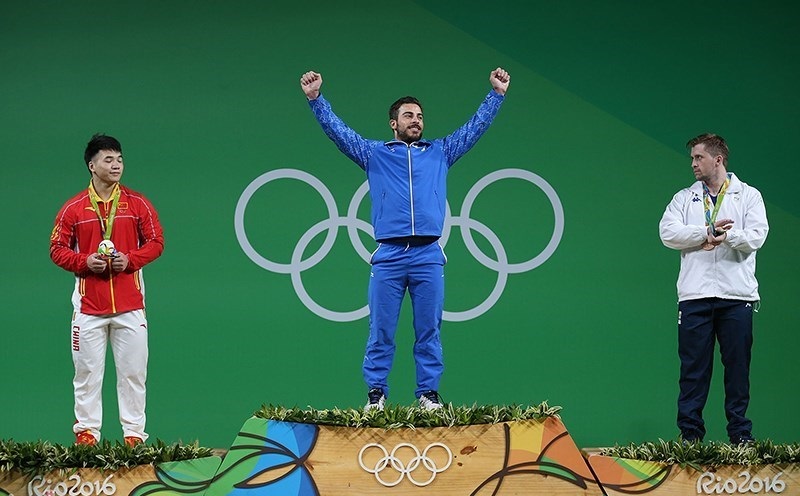
Five Olympic records were broken during the competition. In the men's 69 kg event, Kyrgyzstan's Izzat Artykov originally won bronze but was disqualified after testing positive for strychnine. In the men's 77 kg event, the Court of Arbitration for Sport ruled on March 22, 2022, that original gold medalist Nijat Rahimov of Kazakhstan was disqualified for a doping offense; the IOC has yet to redistribute the medals. In the men's 85 kg event, the Court of Arbitration for Sport stated on December 8, 2016, that original bronze medalist Gabriel Sincraian of Romania was disqualified after testing positive for exogenous testosterone.
- Event dates
- 6–16 August 2016
- Venue
- Pavilion 2, Riocentro, Rio de Janeiro
- Number of athletes
- 260
- Men
- 156
- Women
- 104
- Number of events
- 15
- Banned nations
- Bulgaria, Russia
Lore & Background
The weightlifting program at the 2016 Summer Olympics spanned eleven days, with up to three sessions per day: morning (10:00–14:00 BRT), afternoon (15:30–17:30 BRT), and evening (19:00–21:00 BRT). Qualification followed a format similar to 2012, with a total of 260 athletes qualifying through team and individual spots. Host nation Brazil received three automatic men's places and two women's places, while ten spots (six men, four women) were allocated via Tripartite Commission Invitation. The remaining berths were contested in men's and women's competitions.
Reader's Guide
The 2016 Olympic weightlifting competition is notable for doping-related disqualifications that affected the medal standings. In the men's 69 kg event, Kyrgyzstan's Izzat Artykov originally won bronze but was disqualified after testing positive for strychnine. In the men's 77 kg, original gold medalist Nijat Rahimov of Kazakhstan was disqualified by the Court of Arbitration for Sport on 22 March 2022 due to a doping offence; the IOC has not yet redistributed the medals. In the men's 85 kg, original bronze medalist Gabriel Sincraian of Romania was disqualified on 8 December 2016 after testing positive for exogenous testosterone. Additionally, Bulgaria and Russia were banned from the sport for systematic doping. Five Olympic records were broken during the Games. These events underscore the ongoing challenges of doping enforcement in Olympic weightlifting.
Did You Know?
- Bulgaria and Russia were banned from participating in weightlifting at the 2016 Olympics for systematic doping.
- Five Olympic records were broken during the competition.
- Men's 77 kg gold medalist Nijat Rahimov was disqualified in 2022 for doping; medals have not yet been redistributed.
- Men's 69 kg bronze medalist Izzat Artykov was disqualified after testing positive for strychnine.
A Century of Evolution on the Platform
Weightlifting's Olympic journey stretches back further than most modern sports. The discipline first appeared at the 1896 Games in Athens, where athletes performed a one-hand lift and a two-hand lift. It reappeared at the 1904 Olympics with a two-hand lift and an all-around dumbbell event. In those early iterations, every competitor faced the same challenges regardless of their physical size—a stark contrast to the structured competition that would follow. After a gap in the Olympic program, weightlifting returned in 1920 in Antwerp, Belgium, and has been a fixture at every Summer Games since. The 1920 return marked a fundamental organizational shift: athletes were now sorted into distinct weight classes, and the number of those classes, along with the specific weight limits, has been adjusted repeatedly over the decades to reflect changes in the sport and its athletes.
The 77 Kilogram Shadow Over Rio 2016
The 2016 Summer Olympics in Rio de Janeiro produced a result that would linger for years. In the men's 77-kilogram weightlifting event, a gold medalist was ultimately disqualified following a March 2022 decision by the Court of Arbitration for Sport. As of August 2024, the medals in that category had not yet been formally reallocated, leaving a notable gap in the official record. This situation underscores how the finality of Olympic results can be deferred for years, as anti-doping investigations and appeals processes unfold long after the closing ceremony. For fans and historians tracking the medal table, the 2016 men's 77-kilogram event remains in a state of administrative limbo, a reminder that the story of an Olympic Games does not always end when the last barbell is set down.
Women Step Onto the Olympic Stage
For decades, Olympic weightlifting was exclusively a men's pursuit. That changed at the 2000 Games in Sydney, where women's weightlifting made its long-awaited Olympic debut. The inaugural women's program featured seven weight classes, establishing a structured competition format that mirrored the men's divisions. This milestone represented a significant expansion of the sport's Olympic footprint, adding new events and new athletes to the Games. The inclusion of women followed the broader pattern of the sport's evolution: from the undifferentiated early competitions of 1896 and 1904, through the introduction of men's weight classes in 1920, to the eventual addition of women's categories in the new millennium. Each expansion reflected growing recognition of the discipline's depth and its capacity to showcase athletes across a wide range of body sizes and competitive levels.
The Pursuit of Multiple Golds
Across more than a century of Olympic weightlifting, a select group of athletes has distinguished themselves by claiming at least two gold medals. These repeated champions form a small but storied cohort within the sport's broader medal history, which spans from the 1896 Athens Games through the 2024 Olympics. The tradition of multiple-medal winners highlights the extraordinary consistency required to dominate a single weight class across multiple Games, a feat made more demanding by the fact that the number of weight classes and their specific limits have shifted several times over the years. Tracking these athletes provides a thread that connects the earliest undifferentiated competitions to the modern, highly segmented format, illustrating how the sport's organizational changes have shaped which athletes could realistically repeat as champions.
Gallery

Frequently Asked Questions
Where and when did weightlifting take place at the 2016 Summer Olympics?
The competition was staged at Pavilion 2 inside the Riocentro complex in Rio de Janeiro, running from August 6 through August 16, 2016.
How many athletes and weight classes were featured in Rio 2016 weightlifting?
A total of 260 lifters—156 men and 104 women—contested across 15 separate weight-category events.
Why were Russia and Bulgaria absent from the 2016 Olympic weightlifting competition?
Both nations were stripped of their quotas because of systematic doping violations, meaning no Russian or Bulgarian lifter was permitted to compete in Rio.
What did a typical competition day look like at the 2016 Olympic weightlifting events?
Up to three sessions ran each day: a morning block from 10:00 to 14:00, an afternoon block from 15:30 to 17:30, and an evening block from 19:00 to 21:00, all in Brazilian time.
How did qualification for the 2016 Olympic weightlifting events work?
The system carried over the 2012 format, with a fixed pool of 260 spots distributed among the 15 categories based on World Championship results and continental allocations.
More in Weightlifting at the Summer Olympics 1-24
Spotted an error? Know more?
This is a living reference — every entry is fact-audited, and reader corrections feed straight into our audit queue. Suggest an edit · See this site's audit record